DMG engine
All engines · Modes and shared controls
Use DMG for handheld pulse basses, four-bit wave tones, and short-register noise.
How the sound is made
Each note uses a pulse, a fixed 32-position wave, or clocked noise. MOTION can step through the sixteen wave shapes. A stepped chip decay runs with the common envelope.
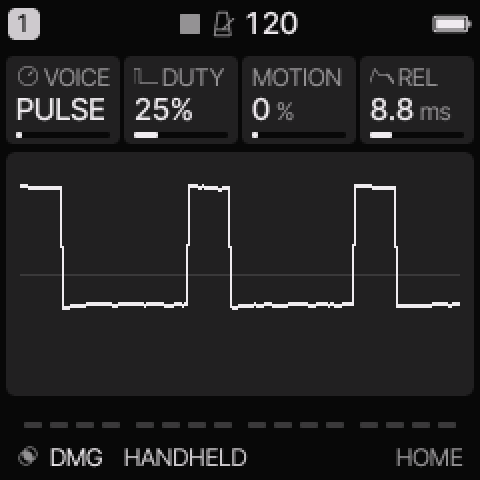 DMG on HOME. These knobs apply to the selected track unless HOME LEVELS is enabled.
HOME knobs
| Knob 1 |
Knob 2 |
Knob 3 |
Knob 4 |
| VOICE |
DUTY / WAV# |
MOTION |
REL |
For HOME LEVELS, see HOME and mixer.
Engine controls
Press the panel EDIT button to cycle the engine pages.
Pause between presses to avoid opening its shortcut layer.
The musical EDIT key is a different control.
WAVE page
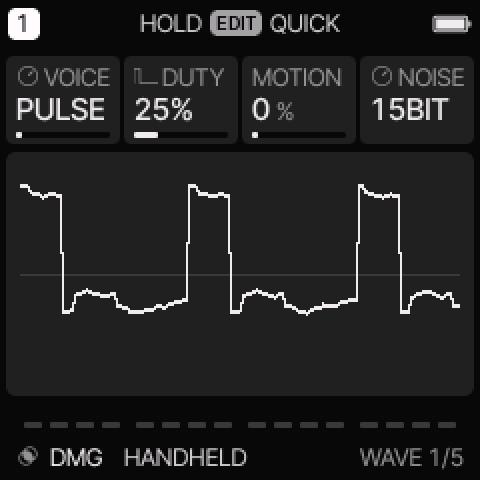 WAVE is engine page 1.
| Control |
What it changes |
| VOICE |
Select PULSE, WAVE, or NOISE. |
| DUTY / WAV# |
In PULSE, select pulse width. In WAVE, select one of sixteen wave shapes. |
| MOTION |
In WAVE, advance through wave shapes. Higher settings advance faster. It does not scan the pulse width. |
| NOISE |
Select 15BIT for a longer noise pattern or 7BIT for a shorter, more pitched pattern. |
MOTN page
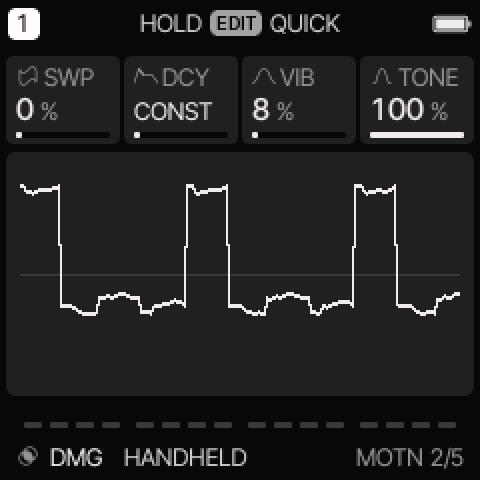 MOTN is engine page 2.
| Control |
What it changes |
| SWP |
Increase the downward pitch sweep. Very small settings have little or no effect. |
| DCY |
Select constant volume, a stepped D decay, or a repeating L decay. |
| VIB |
Increase the built-in pitch vibrato depth. |
| TONE |
Set the output brightness. |
Pulse, wave, and noise modes
PULSE has four widths: 12.5%, 25%, 50%, and 75%.
The saved width range has four adjacent values for each width.
On the device, the second control is labelled DUTY in PULSE and WAV# in WAVE.
Some editor views can show WAV# for this same control.
WAVE contains SQ50, SQ25, SQ12, SINE, TRI, SAW, SAW2, BAS1, BAS2, ORGN,
HOLW, VOXA, VOXO, VOXE, BUZZ, and STAIR.
These shapes use 32 samples with sixteen amplitude levels.
They are fixed built-in waves; this engine does not import custom wave RAM.
NOISE uses 15BIT or 7BIT feedback. 7BIT produces a shorter repeating pattern.
DCY uses the same CONST, D0–D15, and L1–L15 choices as NES.
Higher decay numbers give longer steps. DMG uses a slower decay clock.
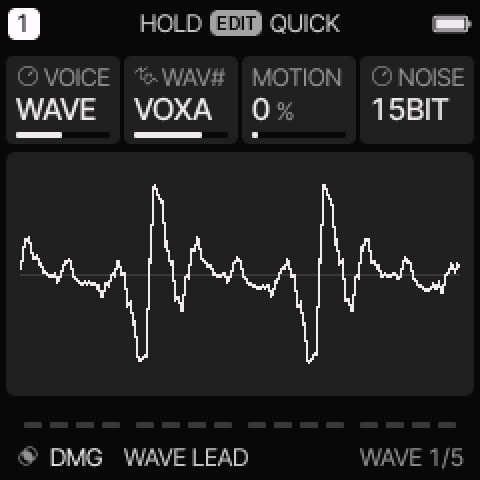 WAVE changes the second control from DUTY to WAV#.
Try these changes
Hear wave motion
Load WAVE LEAD. Select WAVE. Set MOTION low, then increase it while holding a note. Compare this stepped change with WAVE engine scanning.
Make a pitched noise hit
Load 7BIT TOM. Compare 7BIT with 15BIT. Change SWP and DCY to adjust the falling attack and tail.
Factory presets
HANDHELD, WAVE LEAD, SHORT HIT, POCKET BASS, POCKET BELL, POCKET WIND, 7BIT TOM, LINK LEAD.
See the inspired preset catalogue for the references behind the newer sounds.
Limits and useful checks
DMG is handheld-inspired. Its controls do not emulate a complete Game Boy or its channel allocation.
Save a user preset or project before loading another sound if you want to keep your edits.